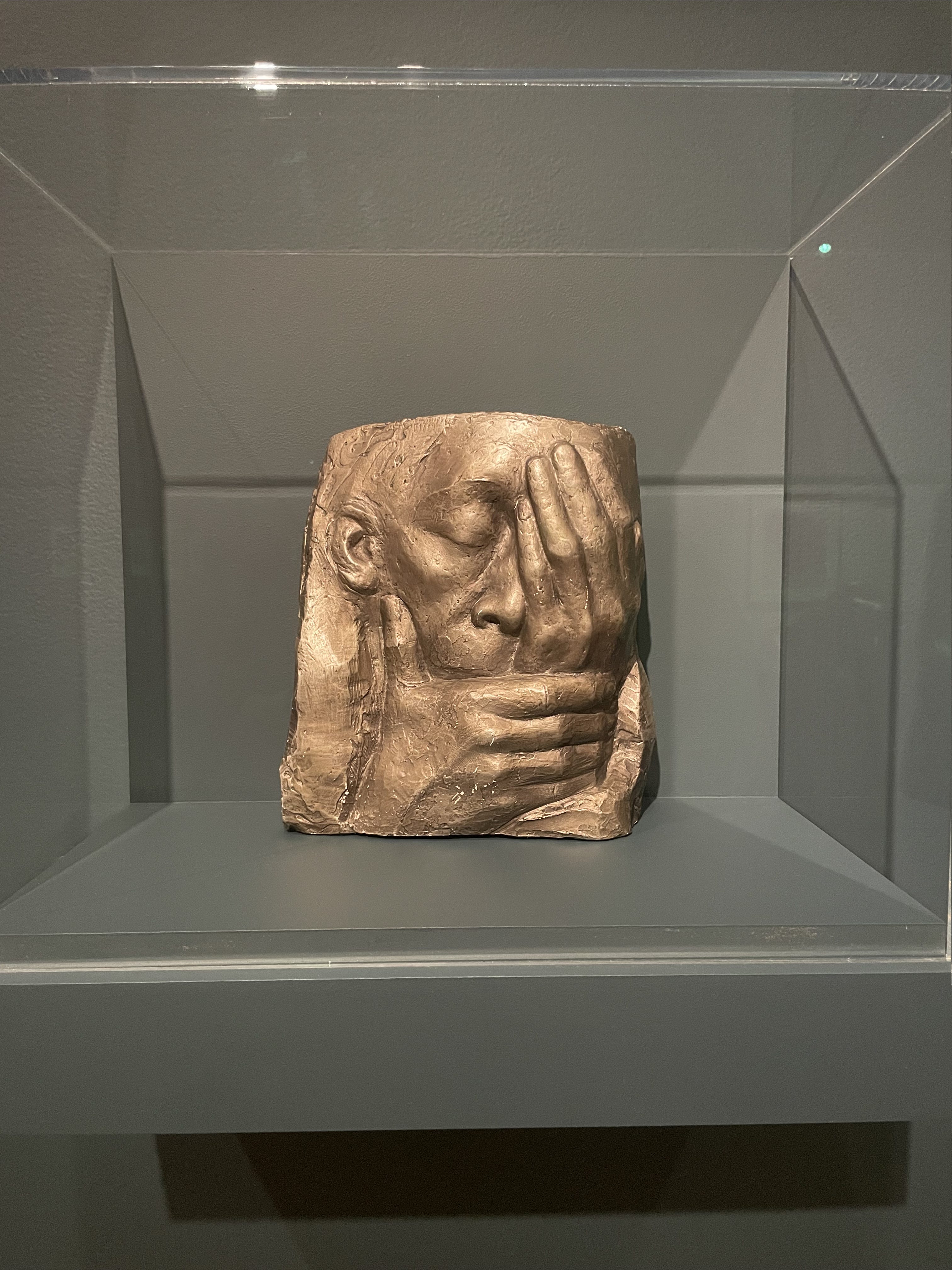
Without Disguises
Käthe Kollwitz at MoMA

I returned from a trip to Paris recently and it altered my brain a little bit. I’ll tell more of the story another time but one of the more dramatic experiences for me happened while going through the Impressionist galleries on the top floor of the Musée d'Orsay. I realized it was something I needed to be spending more time doing, so last weekend I headed to MoMA to finally see “Starry Night,” to get my proper dose of one of my favorite rooms anywhere, the Rothko room, and give a look to the Käthe Kollwitz exhibit.
After “Weaver’s Revolt” and “Woman with Dead Child” I immediately plopped myself on the first bench and started scribbling notes. What follows is the scribbles from that bench, another bench, and then my couch, although the couch was less scribbles and more transcription of scribbles and additional ramblings.
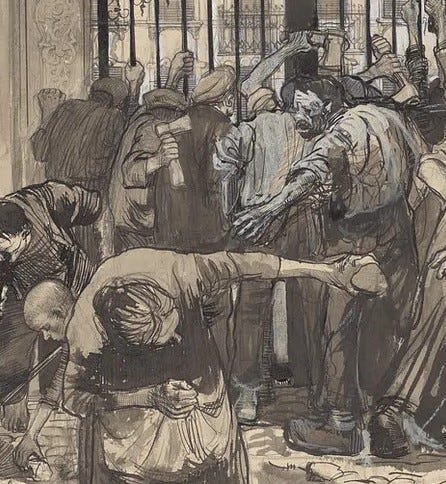
Just finished looking at the plates for “Weaver’s Revolt” including draft sketches for the penultimate and final plates. Something from the sketches almost feels lost in the final plates when you see the inked lines around a man’s outstretched arm in the sketch of the storming of the gates. They spindle around his forearm as if his tendons have given flight from his body and must express their pent up energy to the air alone. But to treat this as something lost takes credit away from the singularity and intentionality of Kollwitz’s vision for her work. As quoted on the opposite side of the gallery, “My work at this time… was in the direction of socialism… [I chose] my objects almost exclusively from the life of the workers.”
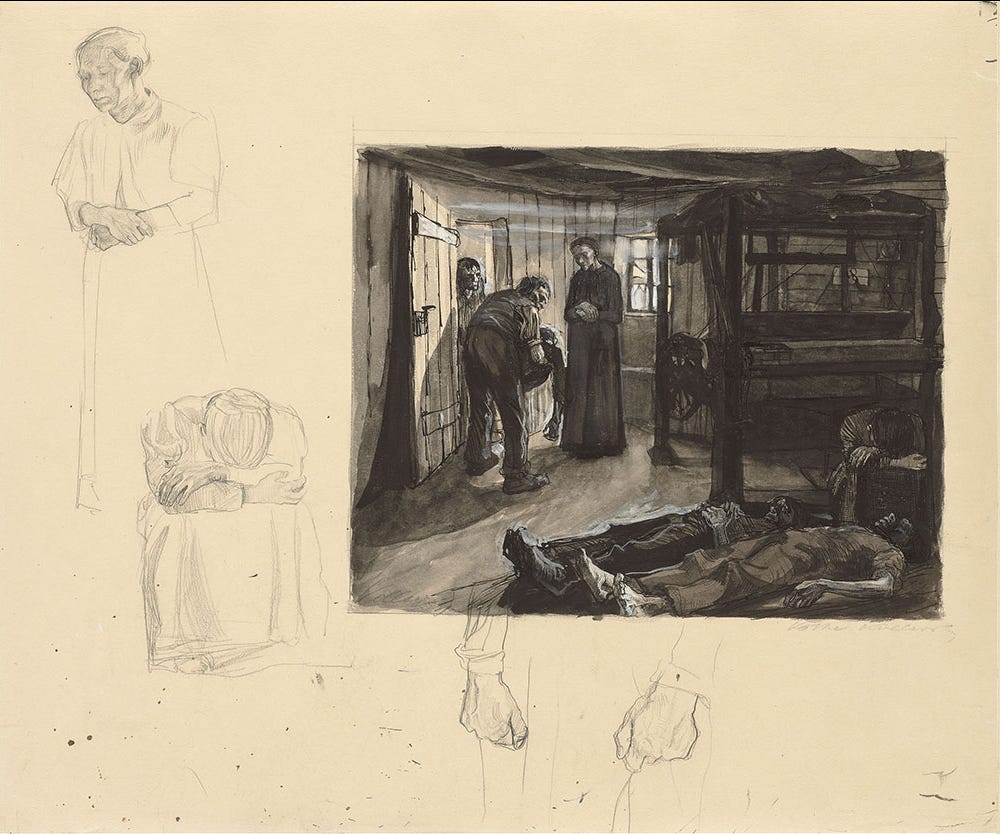
The adjacent sketch of the “The End”, the final panel, bears this out. A solemn figure in the sketch holds her hands together in grief, while below on the page, large sketches of fists are shown resolutely at her sides, defiant in anticipation of a future, inevitable conflict. The fists make it into the final etching.
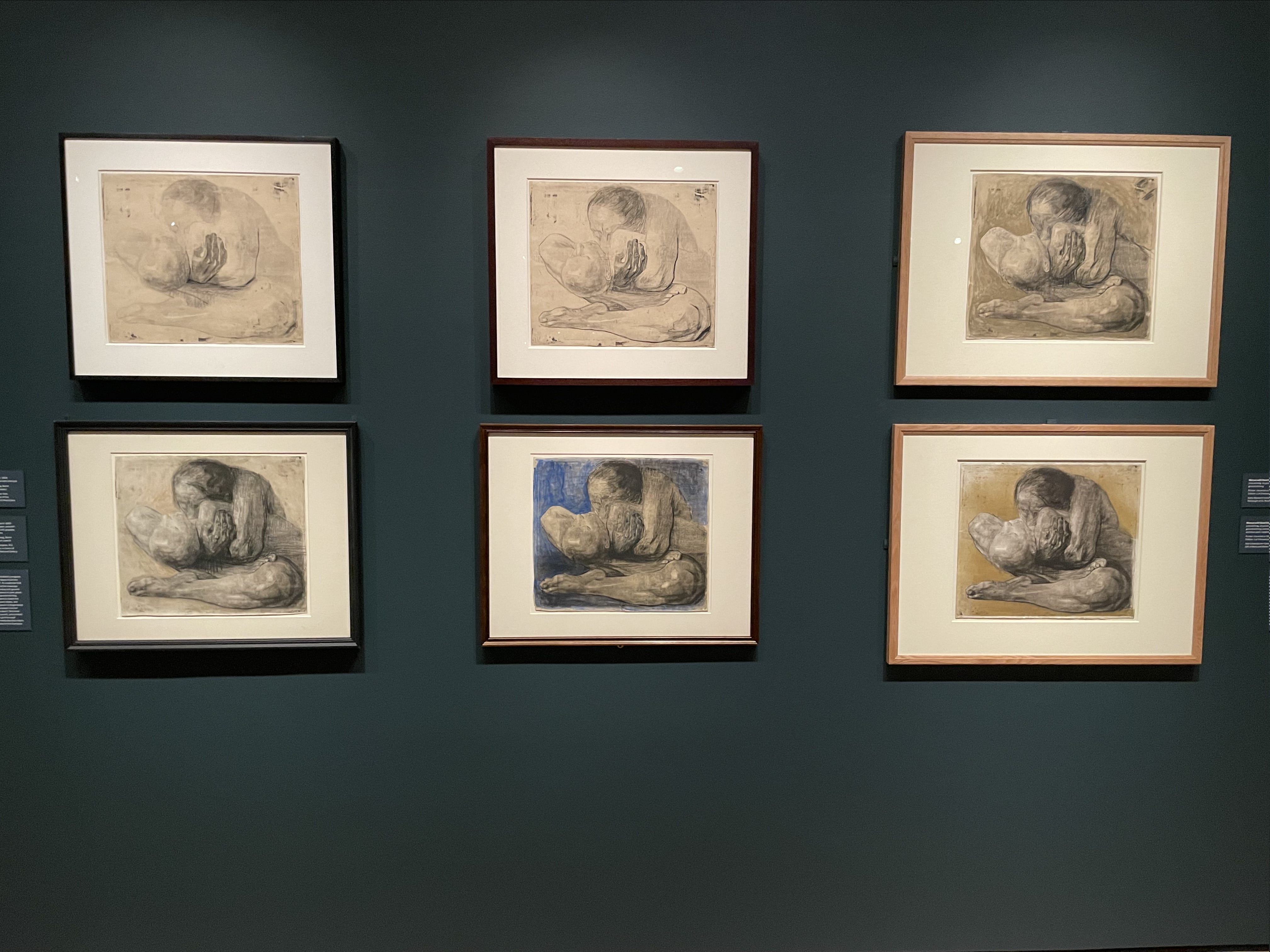
Next to the final version of “Woman with Dead Child” is an entire wall full of studies and various states of the work. We see that Kollwitz was both a striking and focused draftswoman and that her focus caries over to the work itself in ways that, if they are common among renowned artists, are certainly uncommon in being extrapolated in real space by an exhibit. I found myself drawn to a particular draft of the print with a blue background which nudges (shoves, forcefully) the viewer towards a certain flavor of melancholy. A similar blue theme could be found in a different version of the painting nearby, one in which the figures are more distorted.
The final version opts for strong blacks. The trend towards black is a theme throughout Kollwitz’s career, one she will indulge later by opting for woodcuts in depicting scenes of the Great War. The mother’s back is composed of strong vertical lines that make her look like a wild animal, a contrast to the very human head of the deceased child off of which some of the only light shines in the picture. The hair on her head and the detail in her hands also betray something all too human.
Hands for Kollwitz are the mark of both the revolutionary and the worker between which there is no distinction except for the cycle of time. Among her self portraits and renderings of women grieving, her depiction of hands also renders as indivisible her conception of herself as both an artist and a mother. The nail-on-the-head version of this can be found in “Two Self-Portraits.” An image of Kollwitz head-on, pregnant, holding her hand over her heart, sits atop another image of her thoughtfully resting her head on her hand. It almost feels glib to see this image in light of the rest of this exhibit because of how consistently deliberate Kollwitz is elsewhere. In fact I almost laughed when I saw this picture, having already jotted something down in my notebook about the artist/mother details in her work before seeing either this picture or, most dramatically, the “Peasants’ War” series.
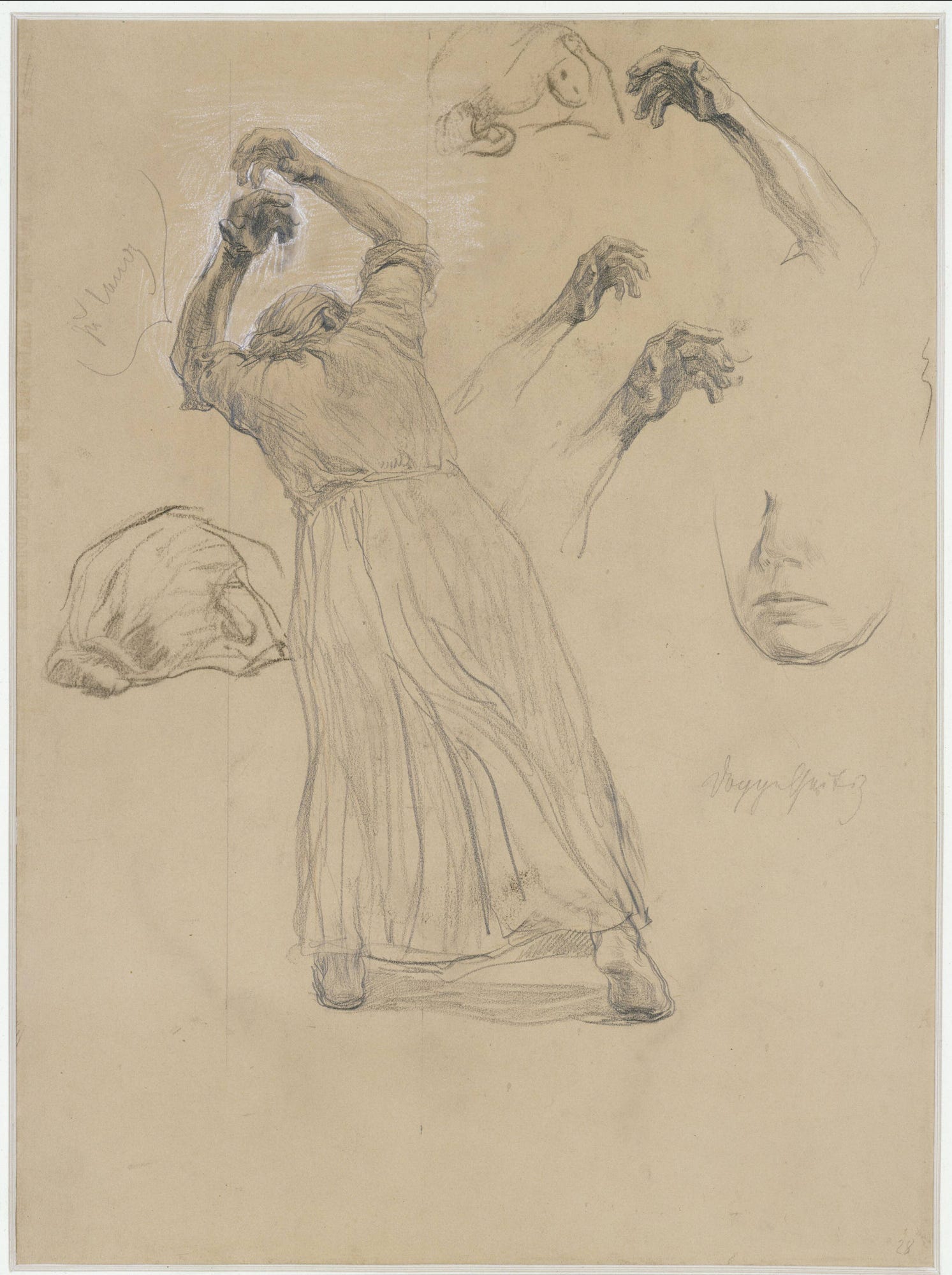
In “Charge” a woman leads an army of workers towards the front of the battlefield. In what manner? She reaches her hands up to the sky, fingers curved, palms towards the viewer as if conducting the soul of the proletariat like a violent symphony. Further down the same wall in the gallery we see a study of the same woman, Black Anna, hands stretched to the sky, flanked by several large, detailed studies of the exact manner in which she held her hands.
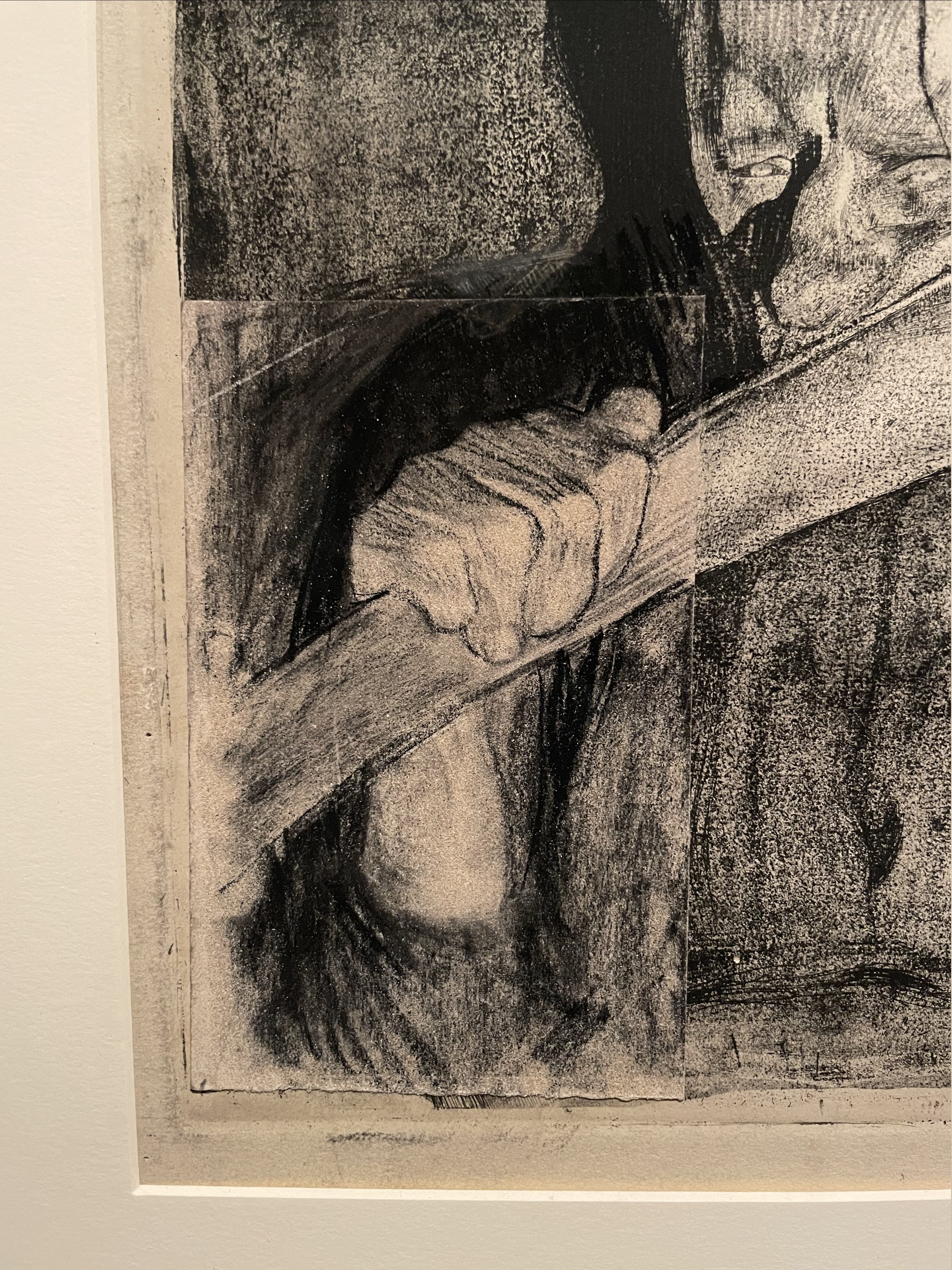
It is the same in another from the series, “Sharpening the Scythe” also from “Peasants’ War” which features in a small room dedicated to Kollwitz’s process of not just updating the composition of a work, but physically altering etchings over time in a draft process that involved pasting full quadrants, as seen above, and using charcoal and pencil to guide her next etched attempt.
Opposite “Peasants’ War” on a wall that divides part of the first gallery room, a few studies for “Uprising” are each themselves stand-out works. Their obvious beauty for Kollwitz is just an inspiring sabot for the delivery of each of her more finely etched bullets. “The Carmagnole” finishes the same wall as one of the finest etchings I’ve ever seen.
If I share partially in one complaint about the exhibit, I would have loved to see more detail about the particulars of her actual print process at various times throughout her career: etching is demanding and she eschews it later on in favor of woodcuts and lithos. Given the singularity of her political motivation and her ability to develop and hone in on her final vision independent of method, understanding the intricacies of her medium of choice at any given time would have been revealing in, I think, an engaging fashion. In the gallery space available, however, I appreciate that this may have been a challenge. A single plate from “The Downtrodden” is the only contribution in this vein. It is stunning and rewards close inspection but could have perhaps also been a platform for further exploration of the medium, especially given the insights into her process of amending prints in the next room. My real disappointment is that nothing similar exists for the practices of woodcutting or sculpture, nor for the lithography that book-ended her career.
By the time you reach Kollwitz’s work during and after WWI — stark, modern woodcuts mixed with lithograph posters for humanitarian causes around Europe after the war— it becomes very hard to ignore the elephant in the room. Her print series for the war is laser focused on the protection and mourning of children in the midst of wars to which they are sacrificed by imperial powers. Nearby posters decry the deaths of children in Vienna and protest laws making abortion illegal. Calling the room timely almost feels cheap. Kollwitz was instructive in her consistent focus throughout all aspects of her work on who the real victims of society are and who is most to blame for driving that cycle of violence and neglect. Moneyed classes subjugate the worker. The state devours the children.
One issue some folks had with the exhibit was its over-emphasis of Kollwitz’s political life instead of her artistry. Aside from my earlier notes about wanting to delve into physical realities of her print mediums of choice, I’m mostly unconvinced by this criticism. I think donors could walk into the exhibit and smear shit on the walls over the existing textual guides and Kollwitz’s work would remain an unflappable testament to both her artistry and her political vision. They were not, after all, dramatically different things: I take the exhibit to be presenting this as an achievement of Kollwitz’s.
The gathering together of individual process works from all over the globe and their arrangement in the gallery as such is a feat and is very much the kind of thing I want from museums with these resources. I’m not sure if class revolt is as inevitable as either Marx or Kollwitz thought but I know this kind of artistry and its appreciation are neither inevitable nor to be taken for granted. With kudos handed out, let me vent for a second.
I have a habit of not taking photos of works directly in front of me at a museum unless something very specific grabs me (I often take a picture of the placard to remember things I haven’t seen before). When I went to see “Starry Night” for the first time later this same day, I did not take a picture of it, because it made no sense to do so. In Paris, I had to remove myself from in front of Van Gogh’s self-portrait at the Musée d'Orsay because so many people were jockeying to stick their phone in his face and I found it physically upsetting.
Unfortunately I regret not taking more pictures of this exhibit because it’s a bit difficult to research online, even when you have the name of the work at times, because different museums don’t necessarily agree on the names of works — many of which are translated or are process works with, frankly, made up names — and searching online catalogues in 2024 is not as easy as it should be because of Google shoving its head up its own ass with AI and the disgusting habit of museums — MoMA included! — of both claiming copyright on non-transformative images of public domain works which they own (good luck with that one in court!) and at the same time making it as hard as humanly possible for the average person to download the goddamn image.
If I wanted to belabor the transitivity of worker -> artist in Kollwitz I could do worse than to start from here. Suffice it to say the exhibit was well presented but even the aspects of the presentation that I enjoyed exist in a broader context of presentation and control that exists to spite Kollwitz’s raison d’etre.


The final room features the last print series, “Death,” completed in 1937. It is disturbing. The prints are crayon lithographs mirroring neither the early etchings or her woodcuts but rather the posters of her most popular and outward facing works and the very first few prints from “Weavers’ Revolt”. The final subject is Kollwitz herself being touched by the hand of death, a hand which was recognizable to me in its depiction from an earlier print in “Peasants’ War.” It feels a little corny for me to say that the hand is so real that it looks almost as if Kollwitz had seen it herself, but in 1937 Nazi Germany, she had.
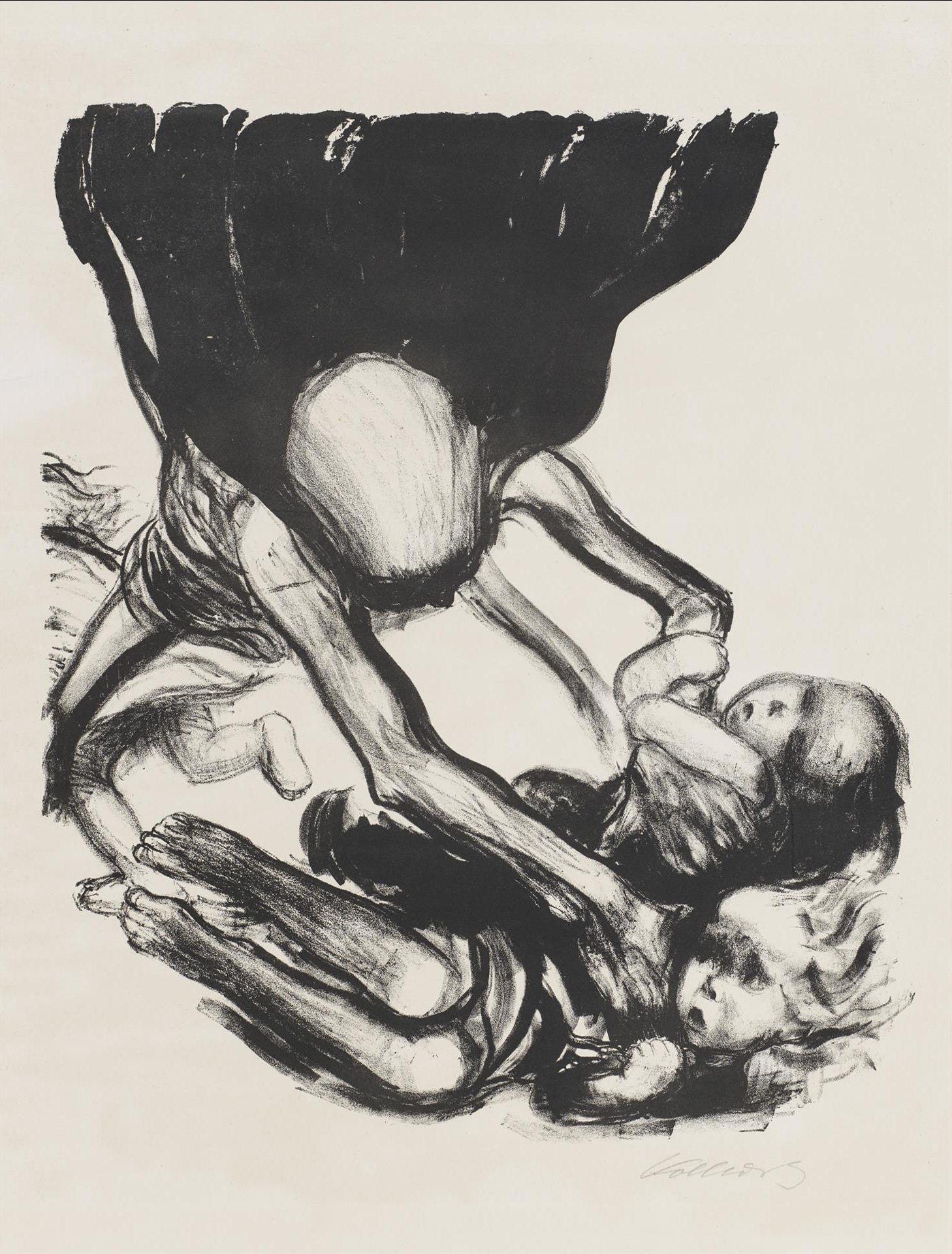
It was something she recognized long before in the suffering of the lower classes. That struggle always felt inevitable to Kollwitz, as inevitable as death. By contrast, the protection of the most vulnerable, the children, was ultimately rendered as not being an inevitability but a necessity; a duty. In “Death”, the plight of children in her work culminates in defenseless children being swept up by a reaper. No mothers to encircle and protect them. Nobody left to cast their hands in bronze around those who were about to need it most.